Anthropic announced higher Claude limits and a compute deal with SpaceX.
The product changes:
- Claude Code’s five-hour rate limits double for Pro, Max, Team, and seat-based Enterprise plans.
- Peak-hours reductions go away for Claude Code on Pro and Max.
- API rate limits go up for Claude Opus models.
Useful. I will take it.
Then there is the compute supplier.
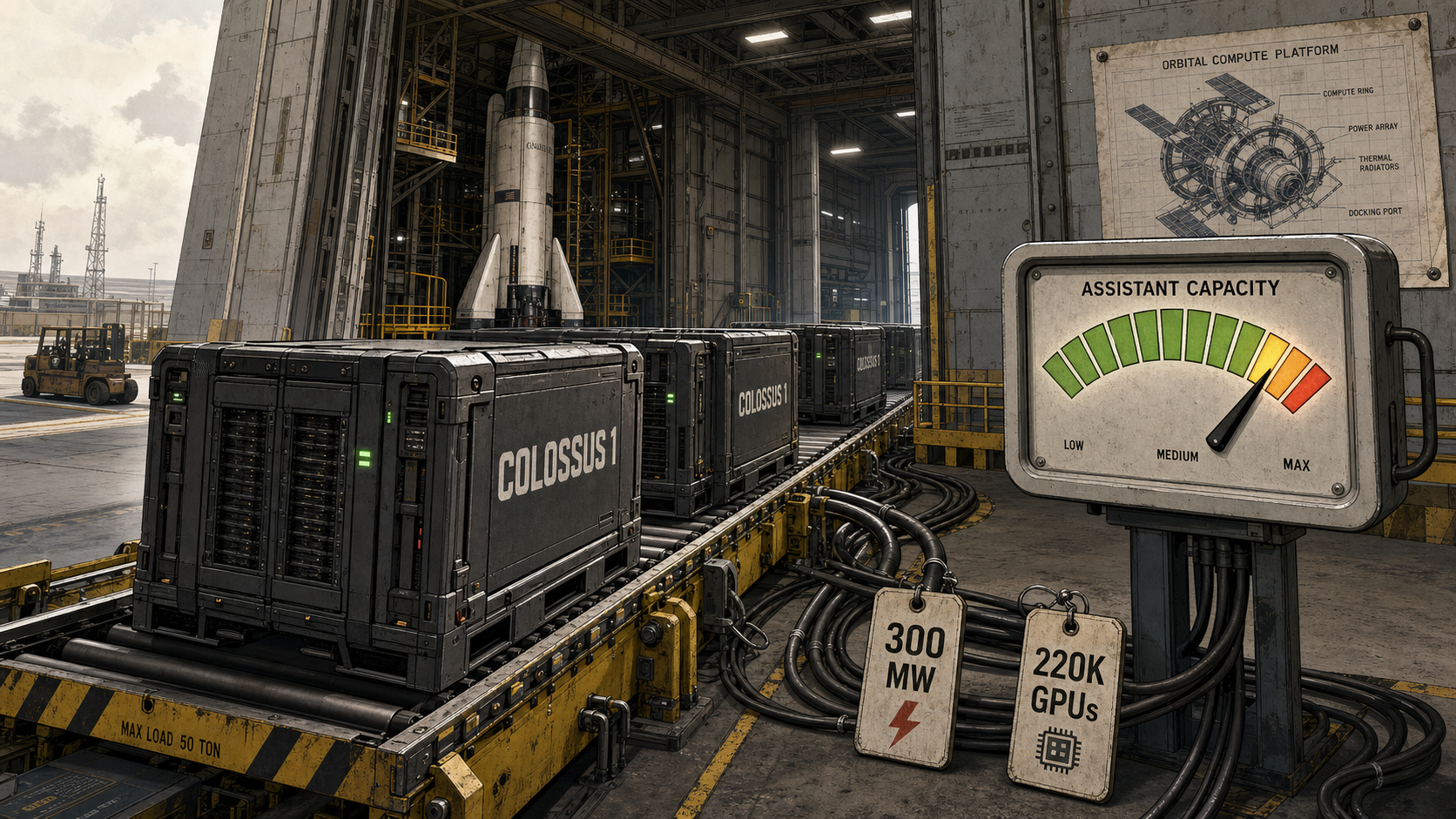
Anthropic signed an agreement to use all of the compute capacity at SpaceX’s Colossus 1 data center. Over 300 megawatts and over 220,000 NVIDIA GPUs within the month. xAI’s post says Colossus 1 includes H100, H200, and GB200 accelerators, and that Anthropic also expressed interest in orbital AI compute capacity.
So Claude is renting capacity from the company that now owns xAI, which makes Grok.
The enemy of my enemy is my compute provider. Very normal industry.
Anthropic is not in trouble. The whole announcement is that demand has been too high for the compute they had. That is a good problem.
But the last couple months have felt messy as a user.
- Claude Code users hit confusing usage limits and rate caps.
- Anthropic changed how subscriptions work with third-party harnesses like OpenClaw.
- Claude Code quality complaints got loud enough that Anthropic published a postmortem. The fix said three product-layer changes hurt some Claude surfaces and the API was not affected.
- Anthropic also sued the Department of Defense over a supply-chain risk designation tied to the red lines Anthropic wanted around mass surveillance and autonomous weapons.
Some of this hit my own work. Claude can still be the best thing available. The frustrating part is when the best thing available becomes throttled or weirdly different from last week. It does not read as “frontier AI is compute-constrained.” It reads as: try again later.
OpenAI spent the same window pushing the opposite message.
The Codex app launched in February with a multi-agent desktop workflow, expanded access, and doubled rate limits on paid plans. GPT-5.5 landed on April 23 with a heavy coding and computer-use story. ChatGPT Images 2.0 shipped two days earlier.
These companies trade momentum every few weeks, so I will not call this a strategic win for OpenAI. From the outside the contrast was still simple: Anthropic looked capacity-constrained, OpenAI looked like it was handing out access, users noticed.
Then the awkward political layer.
SpaceX acquired xAI earlier this year. Elon Musk’s trial against OpenAI started in Oakland on April 28; Reuters reported Musk accused OpenAI, Sam Altman, and Greg Brockman of betraying the company’s nonprofit mission. And earlier this year, Sam Altman and Dario Amodei had that India AI Summit moment where they stood next to each other and would not hold hands for the unity photo. The Indian Express wrote it up. Sounds like a gossip detail until the same companies keep showing up on opposite sides of lawsuits, model access fights, and now compute partnerships.
So yes, the SpaceX deal is funny.
For Msty, this keeps pushing me toward one rule: the workflow should not belong to one provider. If Claude has the best model and capacity that week, route to Claude. If Codex is having a better week, route to Codex. If a local model is good enough for private work, use that. The model choice is a routing decision, not a rewrite of how the team works.
What I am watching after the SpaceX capacity lands:
- Do Claude Code limits stay predictable across a full work week?
- Do API tiers feel less rationed?
- Do product regressions get caught before users start posting conspiracy theories?
- Does third-party tool usage feel like a real path instead of a tax surprise?
The orbital data center stuff can wait. I would just like fewer “try again later” moments while shipping.